The Reading Risk Report gives teachers an overview of students' risk levels for reading difficulties, including potential indicators of dyslexia.
Independent evaluations show Amira achieves up to 98% accuracy in identifying students at risk for dyslexia, and NCII-rated studies demonstrate classification metrics exceeding benchmark thresholds across sensitivity, specificity, and AUC (Area Under the Curve) metrics. The Reading Risk Report leverages the Amira assessment tasks as a screener to calculate dyslexia risk status and provides a quick view by class.
View a walkthrough of the Reading Risk Report
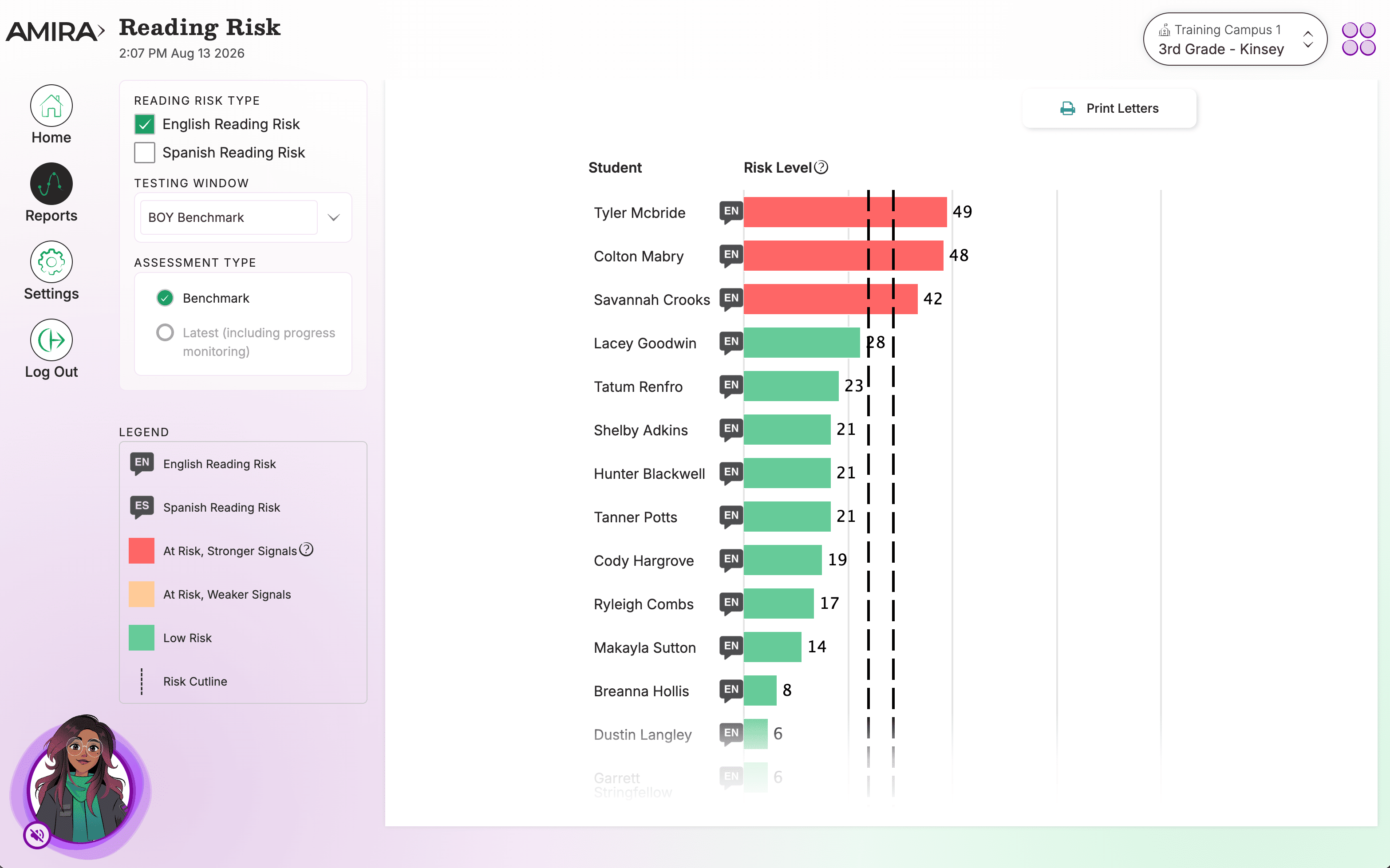
What You'll See
- A Dyslexia Risk Indicator (DRI) score for each student, generated from assessment data.
- Risk classification: scores of 30 or higher are classified as At Risk; scores below 30 are classified as Low Risk.
Amira does not diagnose dyslexia, this report is an early-warning tool, not a clinical determination.
How to Use This Report
Use this report to quickly identify students who may be at risk for reading difficulties, and prioritize them for additional screening, targeted intervention, or specialized support. It also helps ensure alignment with state risk-screening requirements.
Data Source(s): Amira Assess
Update Frequency: Within 24 hours.
Dyslexia Risk indicator Score:
- The Reading Risk Report displays students by risk level, from highest to lowest risk
- The risk level is defined by a Dyslexia Risk Indicator (DRI) score ranging from 0 to 100, with higher scores indicating higher risk of dyslexia
- A score of 0 (zero) is the lowest risk score
- The length of the score bar is 0, so there will be no green bar for a score of 0 (zero)
- A score of -1 indicates that a student took the assessment but Amira was unable to produce a valid score based on limited or no student performance data (typically for early readers still learning letters and sounds)
- DRI scores greater than or equal to 30 are flagged as At Risk while scores below 30 are labeled Low Risk
- The legend is displayed below:
| Metric | At Risk - Stronger Signals | At Risk - Weaker Signals | Low Risk |
| Pre-K - Kindergarten | > 33 | 30-33 | < 30 |
| 1st - 8th Grade | > 36 | 30-36 | < 30 |
Some students may have no DRI score and instead may be labeled with the status of Under Review. This assessment status label indicates recent assessment activity that is under review and may display for up to 3 business days after an assessment has been completed.
Summary: The Reading Risk Report flags students who may be at risk for reading difficulties, including dyslexia, using a Dyslexia Risk Indicator (DRI) score, so teachers can prioritize screening and intervention.
Related Resources