When a student reads an Oral Reading Fluency (ORF) passage during an assessment, Amira aims to create a level of "productive struggle", enough challenge to generate meaningful data, without pushing the student to a frustration point that derails the session.
How Down-Leveling Happens
Amira uses the student's previous assessment (if one exists) plus data from prior tasks in the current assessment to determine the right grade-level passage. If the student performed well on prior tasks/assessments, they receive an on-grade-level passage. If they performed poorly, they receive a passage one grade level below. This logic applies to both English and Spanish content.
Amira automatically up-levels a student when:
- They read the first page with a WCPM (words correct per minute) percentile greater than 95 for their grade.
Amira automatically down-levels a student when:
- They read fewer than 8 words after 60 seconds on the first page, or
- Their accuracy rate falls below 60% by the end of the first page.
As a student continues reading subsequent passages, Amira keeps applying these same criteria and will continue up-leveling or down-leveling as needed.
If a student is reading with reasonable pace but missing several words, Amira will generally let them continue through the passage rather than down-leveling right away, this gathers as much data as possible to produce the most accurate picture of the student's ability.
The Kindergarten Passage and Early Reader Status
The kindergarten passage, built from CVC words and Dolch high-frequency words, is the lowest level passage available in the assessment.
If a student struggles even at this level, encourage them to:
- Sound out words,
- Read the words they know,
- Skip unknown words, and/or
- Say the letters they recognize.
As long as the student makes an effort for one minute, Amira will credit the reading session.
Students who can't complete the kindergarten passage are marked Early Reader on the Growth Dashboard's ISIP Assess Status widget. These students are automatically placed in the Early Reader Skills Scaffold for their next Tutor/Tutora practice session. See: Early Reader Skills Scaffold Overview.
Note: If you believe a student would benefit from the Early Reader Skills Scaffold even though Amira didn't place them there automatically, you can manually assign this via the Practice Mode field under the Tutor Settings tab on the Settings page. See: Tutor Settings Walkthrough.
How Down-Leveling Affects Scores
Down-leveling exists so the assessment can gather enough information to produce a useful, valid score, it doesn't automatically mean a lower score.
Different ORF passages vary in difficulty, and that difficulty affects how quickly and accurately a student can read. A passage one grade level down is generally easier than an on-grade passage, so raw scores alone aren't directly comparable across passages. Without some kind of adjustment, this would cause Amira to overstate or understate a student's actual ability depending on which passage they read.
To correct for this, Amira's psychometric models adjust raw Words Correct Per Minute (WCPM) scores based on each passage's relative difficulty. This means a down-leveled student's easier passage is accounted for, so their adjusted score reflects their ability more accurately relative to peers who read the on-grade passage.
For example: a 2nd grader who reads the 2nd-grade passage at 30 raw WCPM will end up with a higher adjusted WCPM than a 2nd grader who reads the 1st-grade passage at the same raw 30 WCPM.
The Size of the Adjustment
As a rough illustration: for the Winter (MOY) assessment window,
- A 2nd grader reading the on-grade (2nd grade) passage at 30 raw WCPM can expect an adjustment of about +12 points.
- A 2nd grader reading the down-leveled (1st grade) passage at 30 raw WCPM can expect an adjustment of about , 2 points.
That's a difference of about 14 points in adjusted WCPM between the two scenarios, even though the raw score was identical.
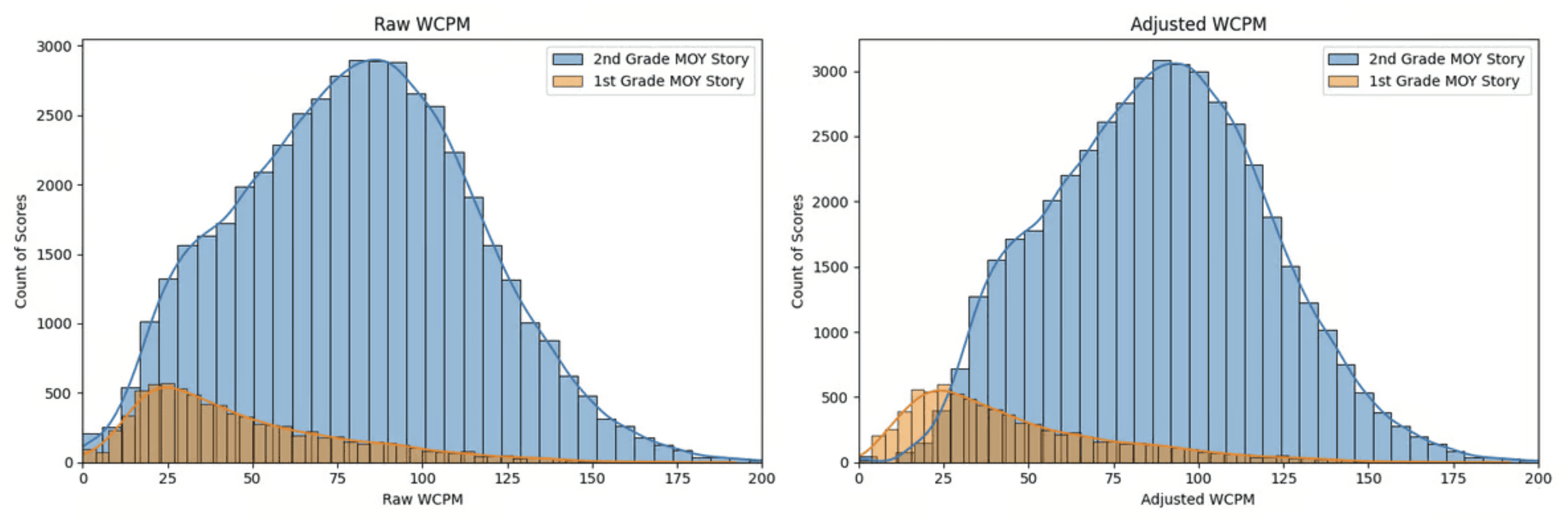
This adjustment is derived from a combination of Amira's empirical passage data and text complexity measures, and the exact magnitude varies by grade and assessment window.
What the Adjustment Does, and Doesn't, Guarantee
The adjustment brings the score distributions of on-grade and down-leveled readers much closer together and more comparable, but some overlap will always remain. Down-leveling is a real-time judgment Amira makes during the assessment to try to generate the most psychometrically valid score possible; it isn't a guarantee that a down-leveled student will score lower than every student who read the on-grade passage.
In fact, research shows down-leveled students are sometimes stronger readers than their raw down-leveling status would suggest, for a few reasons:
- The student didn't try hard or engage with the initial passage.
- The student gave up after hitting a few difficult words.
- The student was just below the cut line for success on the on-grade passage, then read fluently once given a slightly easier passage.
That said, down-leveled students score below the 30th percentile rank for their grade about 75% of the time, exceptions happen, but they're not the norm.