Amira measures reading comprehension by triangulating several distinct tasks rather than relying on a single test format. Each task is mapped to a specific strand of Scarborough's Reading Rope, and together they produce a holistic, normed picture of a student's comprehension skill, reported as a Language Comprehension Percentile Ranking relative to grade-level peers.
The five core comprehension measures
| Task | Reading Rope Strand | How Amira Assesses It |
|---|---|---|
| Reading Comprehension | Language Comprehension | The student reads a short text passage on-screen, then Amira asks up to 5 comprehension questions about it in a multiple choice format. |
| Listening Comprehension | Language Comprehension | The student listens to a passage read aloud (narrated by an actor on video) without seeing the text, then answers questions about what they heard. This isolates comprehension from decoding ability. |
| Vocabulary | Vocabulary | This task consists of selecting synonyms or related words of certain target words. |
| Spelling | Language Structure | The student spells a word after hearing it articulated aloud. |
| Oral Reading Fluency (ORF) | Language Comprehension (via Word Recognition) | The student reads a passage aloud; Amira scores fluency in Words Correct Per Minute (WCPM), on a 0 to 200 scale (200 is the maximum). |
The number of questions Amira poses for the reading and listening comprehension tasks varies by grade level and by how the district has configured the assessment.
Why five measures instead of one
Amira's philosophy is to employ multiple measures and triangulate a large number of measurement points, in order to reduce bias and improve accuracy, Amira captures roughly 10x the measurement points of a traditional single-format comprehension test. Rather than asking one type of question in one format, Amira blends:
- Direct measures of comprehension (Reading Comprehension, Listening Comprehension)
- Indirect measures that research shows are closely tied to comprehension (Vocabulary, Spelling, Oral Reading Fluency)
This combination lets the underlying psychometric model draw on multiple perspectives at once, rather than depending on any single task type to carry the full weight of the score.
The Comprehension Percentile Ranking itself is generated as a rollup of the student's Vocabulary and Background Knowledge/Structures performance, while Reading Comprehension and Listening Comprehension are also reported as their own related-but-distinct sub-scores, since research shows these two are correlated, but not identical, skills (see below).
Amira Comprehension Conversations (Amira Tutor)
Beyond the assessment itself, Amira Tutor extends comprehension measurement into everyday practice through Comprehension Conversations, developed in collaboration with Dr. Nell K. Duke (University of Michigan). During tutoring sessions, students engage in open-ended, spoken dialogue with Amira and receive personalized coaching in the moment, rather than only answering multiple-choice or cloze questions.
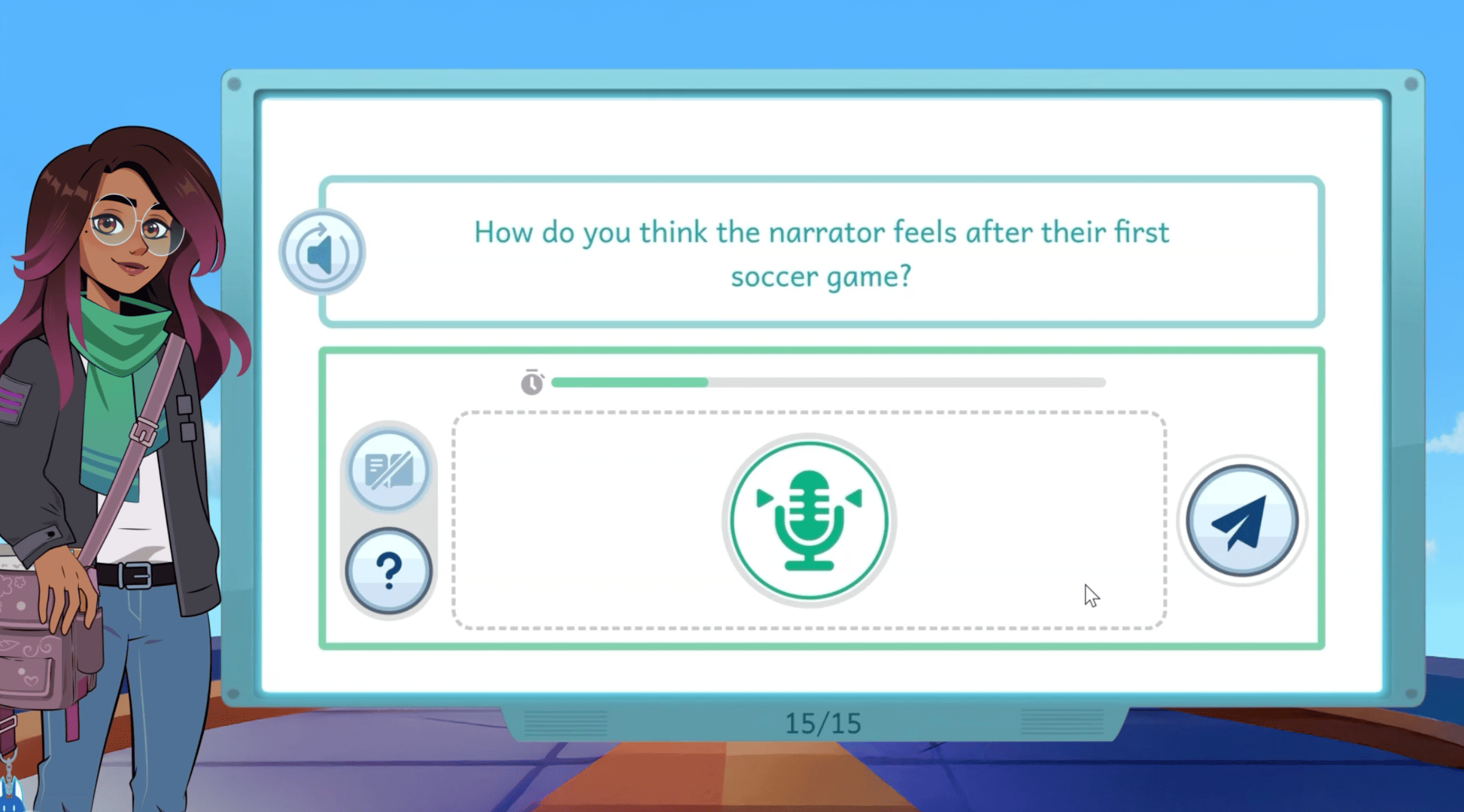
Through these conversations, Amira:
- Asks open-ended questions that require students to make inferences, summarize, and construct meaning, not just select an answer.
- Coaches students who struggle, guiding them to read closely, identify key information, and build active-comprehension strategies.
- Probes for text structure, rhetorical style, and author's craft, asking students to reflect on tone, purpose, and stylistic choices, and using concrete examples from the text when a student needs support recognizing these elements.
- Applies targeted micro-interventions, Amira draws on a library of micro-interventions covering language comprehension (in addition to a separate library covering word recognition), to match coaching to the specific gap a student shows in the moment.
Because these conversations happen through natural spoken dialogue rather than fixed-choice questions, they let Amira continuously monitor comprehension growth during practice, not just at benchmark or screening windows.
Watch a Video of a Comprehension Conversation
The research behind Amira's approach
Listening and reading comprehension are related but distinct skills. Sticht and colleagues' synthesis of the research literature found listening and reading comprehension to be highly interrelated, sharing the same general comprehension processes once decoding is mastered (Sticht, Beck, Hauke, Kleinman, & James; Sticht et al., 1974; Sticht & James, 1984). In younger students who haven't yet mastered decoding, listening comprehension signals their eventual capacity for reading comprehension. Diakidoy (2005) found the correlation between the two strengthens after Grade 2. However, Wolf (2018) showed that while the two share substantial variance, neither fully explains the other, which is why Amira reports each independently rather than merging them into a single number.
Fluency and comprehension are bidirectionally linked. This relationship sits at the heart of the science of reading, often summarized as LC × WR = RM (Listening Comprehension multiplied by Word Recognition equals Reading Mastery). Studies of reading fluency components have found strong correlations between Reading Comprehension and Word Reading Fluency, which is why Oral Reading Fluency is included among Amira's comprehension-related measures rather than treated purely as a decoding metric.
Spelling reflects language structure knowledge. Young children's spelling attempts reflect their developing knowledge of language and print (Hughes & Searle, 1997; Treiman, 1998). Carreker (1999) argued that spelling instruction, and by extension spelling assessment, should reflect a student's broader thinking about language structure, not rote memorization of individual words (Kelman/Apel). This is why Amira treats spelling as a window into language comprehension rather than a stand-alone skill.
Psychometric grounding
Amira's scores are generated using Item Response Theory (IRT) models, with reliability (internal consistency) coefficients exceeding .9 and correlations of roughly .8 with other established, leading reading assessments. Differential item functioning (DIF) analysis has been used to confirm the assessment measures reading ability equivalently across gender, ethnicity, and race groups, and a Reading Error Detection (RED) process helps the underlying voice-recognition model score oral reading accurately across a wide range of accents and dialects, helping ensure comprehension-adjacent measures like Oral Reading Fluency aren't skewed by factors unrelated to reading skill.
In summary
Amira doesn't measure comprehension with a single test format. It combines direct reading and listening comprehension tasks, open-ended spoken Comprehension Conversations during tutoring, and closely correlated indirect measures (vocabulary, spelling, and oral reading fluency) into one Language Comprehension Percentile Ranking, while still reporting reading and listening comprehension separately, since the research shows they are related but distinct skills worth tracking on their own.