Math assessments use an automated computer adaptive testing (CAT) system that automatically assigns a monthly assessment to each student.
The monthly assessments are given the first time a student logs on during a calendar month. For example, if a student logs in on September 1, an assessment will be given. If the student doesn't log in until September 15, an assessment will still be given when the student logs in.
Additional on demands assessments can be given at any time during the school year.
Assessments can be used as benchmarks and as continuous progress monitoring tools.
Assessment Details
Computerized Adaptive Testing (CAT)
- Measure a student's reading ability and skill development.
- Test questions range from easy to difficult.
- Based on student responses to test questions, the assessment will adapt to precisely measure student ability within subtests.
Ability Index
- Measurement scale that aligns student performance levels in the ISIP Assessments with an Instructional Tier or Level.
- Used to inform instruction regarding student strengths and weaknesses.
- Based on individual student performance.
- Available as an Overall Reading Ability as well as individual subtest ability indices.
Assessment Best Practices
- For consistency in reports, Amira Learning recommends that all students log on monthly to take the ISIP Assessment. This will help show true growth over time for the population of Amira Learning users.
- Establishing a consistent assessment window at the beginning of each month allows maximum time for classroom instruction, student intervention, and student use of Instruction to take place between assessments.
- Properly logging out of Amira Learning ensures student data is properly recorded. This entails selecting the logout button and waiting until the "You have been logged out" screen is reached.
Assessments by Grade Band
Math
Students are assessed in the domains shown below by grade level.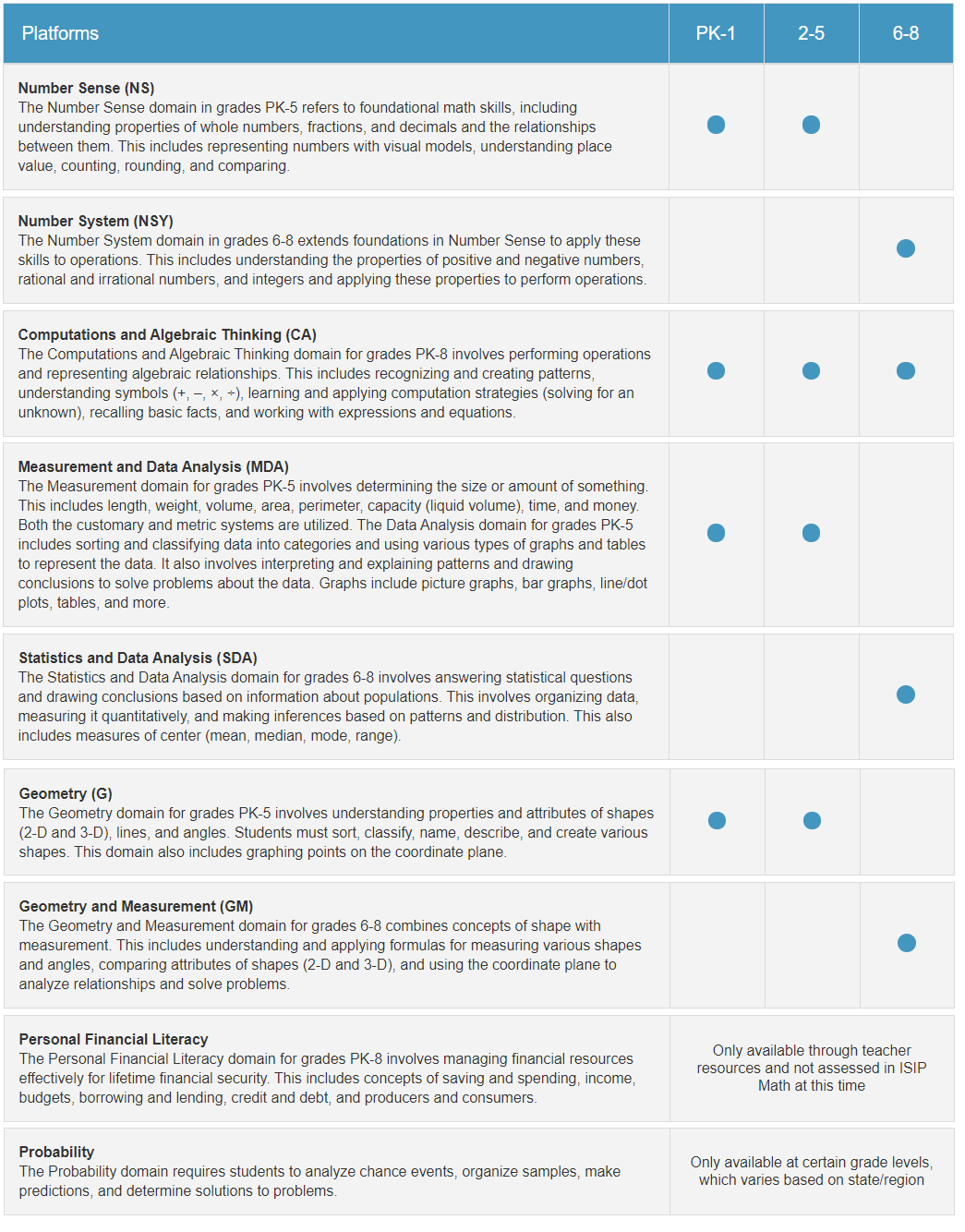
Assessment Scoring
Math
Our assessment integrates computer-adaptive testing that accurately reflects the mathematical ability level of each student and measures growth over time. When administered regularly, it is possible to observe whether a student, or an entire classroom, district, or school, is making adequate progress in critical mathematics areas. Adaptive assessments use interactive content to measure a student’s mathematical ability.
Based on the item development process at Southern Methodist University’s Research in Mathematics Education department (RME), the relative ease of each item on the Early Math (PK, G1) test and Math (G2, G8) test was identified as easy, medium, or difficult. Items were also identified according to their level of cognitive engagement.
The difficulty of the test questions presented changes with every response to identify the student's overall math ability. If a student answers questions correctly, the test presents more challenging questions until the student shows mastery or responds with an incorrect answer. When a student answers a question incorrectly, the test presents less difficult questions until the student begins answering correctly again. The ability score is an estimate of the student’s mathematical ability.